AI Summary (For Busy Readers)
What This Blog is About:
This is a very straightforward explanation of data enrichment and data cleansing and their major differences. This blog will also showcase how these techniques perform in such a way that business data quality, decision-making, and customer engagement are all improved.
In Short:
The primary goal of data cleansing is to get precise information. This process includes rectifying errors, removing duplicate entries, and making the data uniform.
On the other hand, Data enrichment is associated with importing new significant information from reliable sources, which, subsequently, turns ordinary data into strong insights.
Why This Difference Matters:
Errors will be avoided with clean data. Enriched data gives access to opportunities. They are the ones that allow the teams to get quicker, smarter, and more certain in their business moves — whether it is marketing, sales, or operations.
Real-world Impact:
- A marketing team has no contact with dead leads because they have a clean and verified contact list that costs no money.
- An enriched profile provides a sales team with essential details such as company size, role, and intent, thus closing more deals.
- A business leader looks at complete, trustworthy analytics rather than fragmented reports.
Bottom line:
- Data cleansing allows you to have complete trust in your data.
- Data enrichment allows data to serve you.
- As a result, the combination of the two transforms your CRM from a mere record-keeping tool into a revenue-generating engine.
The quality of data in any organization governs the quality of its decisions. The accuracy, completeness, and usefulness of data are the basic needs for the smooth operation of the sales, marketing, and customer support areas. However, the best systems are sometimes not able to manage the situation due to the constant data flow, mistakes, and lack of data.
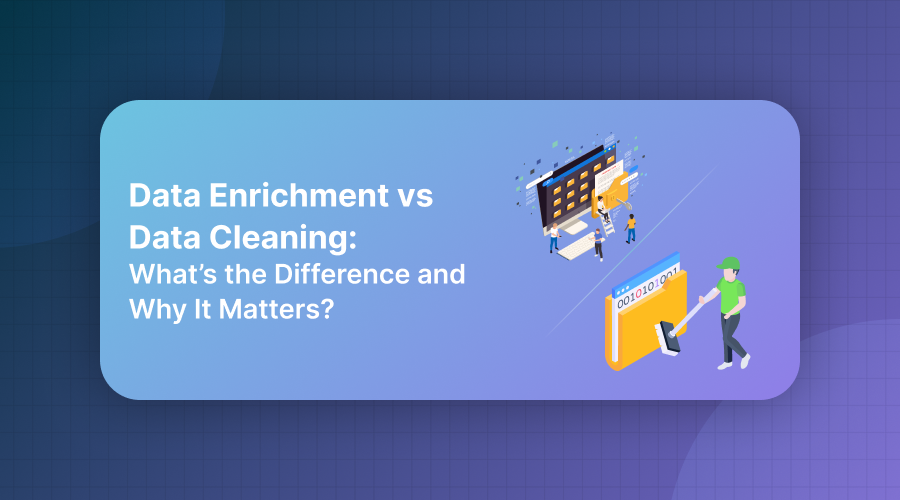
That is the moment when data enrichment and data cleansing take the stage. Both processes are pretty significant in maintaining a clean database, yet they differ in their functions. To put it simply, data cleansing is concerned with removing the incorrect and sanitizing the correct, whereas data enrichment deals with adding the incorrect and improving the correct.
Now, let’s go deeper to discover their differences, advantages, and understand how these terms are significant for your business to grow.
What Is Data Enrichment?
Data enrichment is the practice of increasing the value of an existing dataset by consolidating data with relevant data points. This involves aggregating and enhancing internal data, which may or may not include customer data points from your own CRM, and/or external data sources, such as demographic or firmographic, or behavioral data points, in a focused effort to build a 360-degree customer profile.
For instance, if your sales database notes just the customer’s name and email, when you add enrichment, you could append information such as their title, company, industry, or social media profiles, allowing your team to create a more customized outreach, and more effective outreach strategy.
In simple words, with data enrichment, companies can:
- Gain additional insights into your customers
- Better target and segment your audience
- Personalize communication and engagement
- Provide sales teams with context that is more meaningful.
- For more information you can also checkout Benefits of Data Enrichment
What Is Data Cleansing?
Data cleansing is the process of identifying and correcting inaccurate, incomplete, or duplicate records in a dataset. It ensures that your database remains accurate, reliable, and free of inconsistencies that could mislead business decisions.
For example, if your CRM has outdated phone numbers, duplicate entries, or incorrect email addresses, your marketing campaigns may underperform. Data cleansing eliminates errors like correcting typos, standardizing formats, and deleting redundant data to keep your records consistent and useful.
It’s like decluttering your data, removing what doesn’t belong, and polishing what remains.
Data Enrichment vs Data Cleansing: Know the Difference
Although both processes work hand in hand to improve data quality, they serve distinct purposes. Here’s how they differ:
| Aspect | Data Cleansing | Data Enrichment |
|---|---|---|
| Primary Goal | To correct, remove, or standardize data for accuracy. | To add new, relevant information that enhances data depth. |
| Focus | Accuracy, reliability, and integrity. | Completeness, value, and context. |
| Key Activities | Fixing typos, removing duplicates, correcting invalid entries, and standardizing formats. | Appending new fields like job titles, industry, demographics, or company size. |
| Example | Correcting “Jonh” to “John” and updating phone numbers. | Adding John’s company name, job title, and LinkedIn profile. |
| End Result | Clean, accurate, and usable data. | Enriched, insightful, and actionable data. |
Think of data cleansing as tidying your room and data enrichment as decorating it. One removes clutter; the other adds value. Together, they ensure your business data is both accurate and meaningful.
How Does Data Enrichment Help to Grow Your Business?
Data enrichment can completely transform the operation of a business, taking it from merely making assumptions to drawing up new conclusions and KPI. When used for data analysis, insights from enriched data will already be available. Businesses can easily understand customers, markets, and performance metrics in a much clearer way, thus paving the road for major departmental growth across all divisions.
Benefits of Data Enrichment:
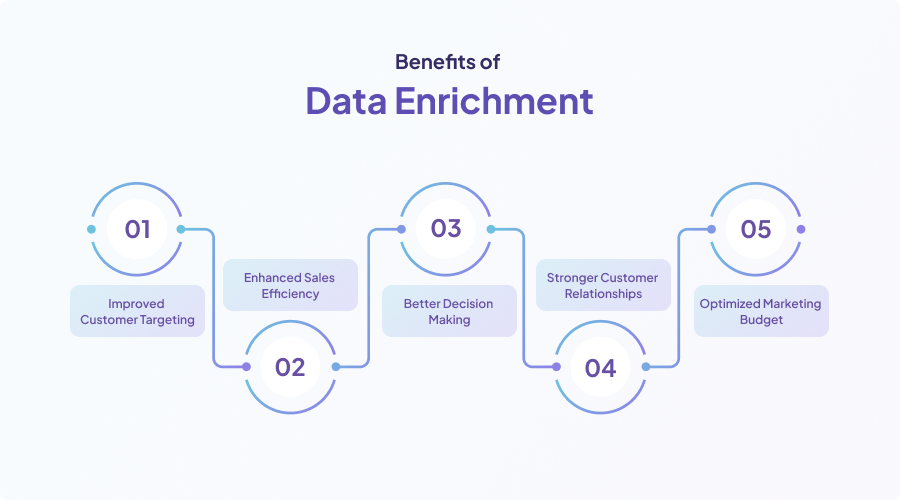
- Improved Customer Targeting: It’s surely a fact that with the help of data enrichment, customer targeting and retargeting gets improved. For example, different types of data, such as demographic, behavioral, and preference data, can be mixed and matched to produce a super target that fits the campaign like a glove.
- Enhanced Sales Efficiency: By knowing which ones are most likely to buy, the salespeople can give their attention only to those people and therefore not lose anything in terms of the rate of conversion.
- Better Decision Making: Businesses will be able to take the right step by using enriched data to support their decision process rather than depending on conjecture.
- Stronger Customer Relationships: Using the knowledge gained from seeing and understanding the customer through their viewpoint, the company can tailor their interaction and eventually cause the customer to be content.
- Optimized Marketing Budget: With the help of in-depth and precise customer profiles, marketing departments can be sure that their expenditure is not only effective but also targeted at the right people.
Understand Data Enrichment Better Through This Use Case:
A SaaS company uses data enrichment to enhance its lead database by adding job roles and company sizes. With this information, the marketing team tailors campaigns for decision-makers in mid-sized firms, resulting in higher engagement and a 30% increase in qualified leads.
How Does Data Cleansing Support Your Business?
Regardless of how sophisticated CRM systems are, their performance is still highly dependent upon the quality of the data they are supplied with. The process of data cleansing ensures that the company’s data foundation is strong, truthful, and allows the business to operate smoothly.
Benefits of Data Cleansing:
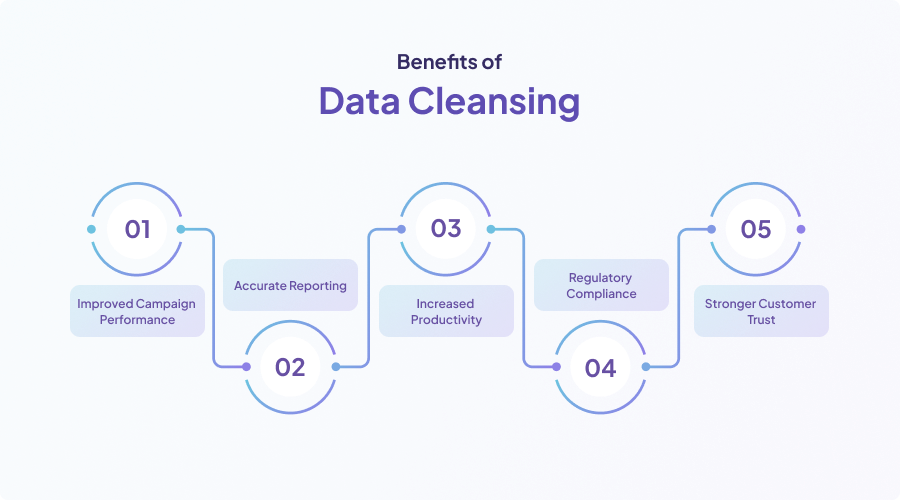
- Improved Campaign Performance: Clean data avoids bounced emails and failed calls, which lead to better reach and engagement.
- Accurate Reporting: Good data means precise analytics, which, in turn, leads to the management being able to make data-backed decisions.
- Increased Productivity: There is less time spent by the team on correcting errors, while more time is devoted to planning and implementation.
- Regulatory Compliance: Clean and verified data secures your compliance with data protection and privacy regulations.
- Stronger Customer Trust: Providing error-free communication is a way to showcase your business as being professional and trustworthy.
Understand Data Cleansing Better Through This Use Case:
A financial services firm regularly cleanses its customer data to remove outdated phone numbers and invalid email addresses. As a result, their campaign deliverability rates improve, and support teams resolve customer queries faster, boosting satisfaction and retention.
Let’s Conclude!
Data cleansing and enrichment are not optional anymore; they are the core and the new necessity for modern business intelligence. Cleansing corrects your data while enrichment gives power to it.
Platforms like Deep Enrich use smart algorithms to filter, verify, and structure reliable data that helps businesses target better and grow faster without depending on AI-generated content.
In the coming days, the companies that give importance to data quality will be the ones who will win the competition because in an information-overloaded world, only clean and enriched data will be the factor that makes the real decision.